
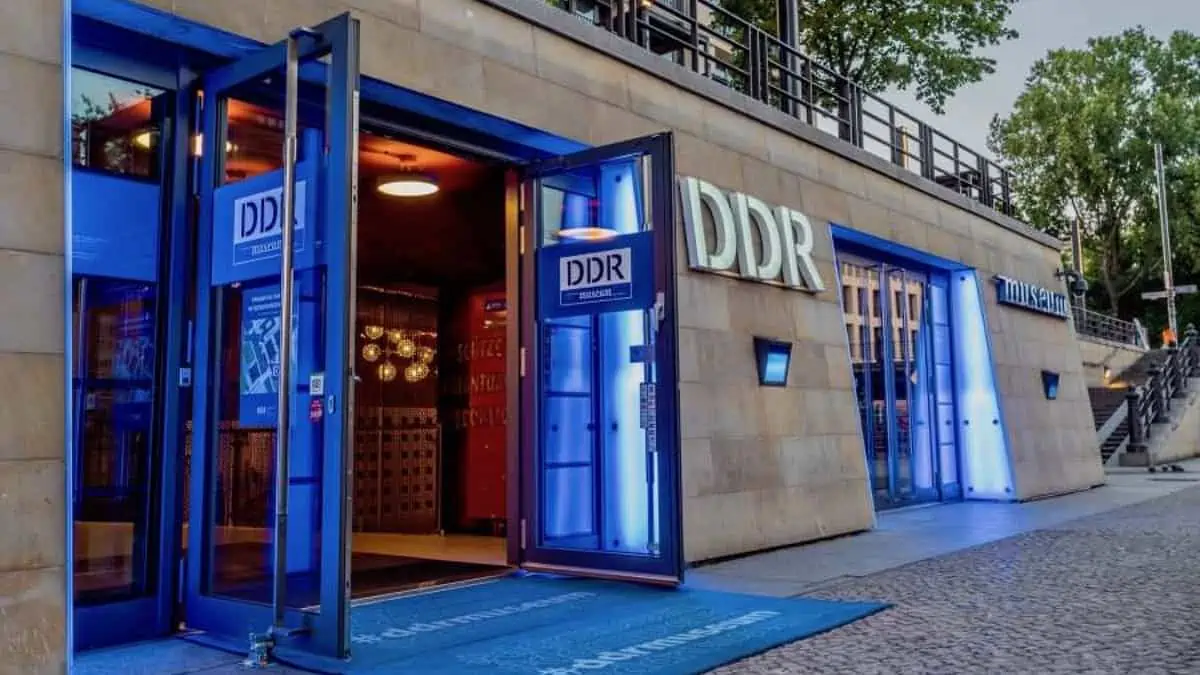
The DDR Museum (Deutsche Demokratische Republik Museum) provides a unique, hands-on look at life in the former East Germany. Located on the banks of the River Spree in the heart of Berlin, it moves away from traditional “look but don’t touch” exhibits. Instead, it invites visitors to open drawers, rifle through cupboards, and interact with the history of a socialist state that existed from 1949 to 1990. It is one of Berlin’s most visited museums, offering an immersive experience that covers everything from the Stasi secret police to everyday housing, holidays, and fashion behind the Iron Curtain.
What to expect at DDR Museum
The DDR Museum focuses on “history you can touch.” The exhibition is designed to simulate the everyday experience of an East German citizen.
- The Trabant Simulator: One of the most popular attractions is the Trabi driving simulation. You can sit in an original Trabant P601 car and drive virtually through a concrete housing estate (Plattenbau).
- Authentic Apartment: Walk through a fully furnished, five-room WBS 70 concrete slab apartment. You can sit on the sofa in the living room, check the pressure cooker in the kitchen, and explore the children’s room, all decorated with original GDR artifacts.
- Interrogation Room: Experience the darker side of the regime in a recreated Stasi interrogation cell, complete with authentic audio recordings.
- Interactive Drawers: Throughout the museum, there are hundreds of drawers and cupboards you are encouraged to open. They contain everything from school reports and authentic food packaging to Stasi surveillance files.
- Themed Areas: The museum is divided into themes such as “Public Life” (work, education, ideology) and “Private Life” (family, media, shortages), helping visitors understand the contrast between state propaganda and reality.
Where to buy tickets
- Online (Recommended): The most efficient way to purchase tickets is through the official DDR Museum website or trusted ticket partners. Buying online allows you to secure a specific time slot, which is crucial during peak tourist seasons (summer and holidays) to avoid long queues.
- On-Site: You can purchase tickets at the museum’s ticket counter upon arrival. However, because the museum is located in a high-traffic tourist area (opposite the Berlin Cathedral), lines can be long, particularly on weekends.
- Berlin WelcomeCard: If you have a Berlin WelcomeCard, you can purchase a discounted ticket either online or at the counter.
DDR Museum’s tickets
Ticket prices are subject to change, but general pricing structures are as follows:
- Adults: Approximately €13.50.
- Reduced: Approximately €8.00. This rate typically applies to children over 6, students, trainees, and persons with disabilities (proof required).
- Children (Under 6): Free admission.
- Groups: Discounted rates are often available for school groups or larger tour groups if booked in advance.
Combo Tickets
Because of its prime location on the River Spree, the DDR Museum is often included in “Combo” packages that can save you money.
- DDR Museum + River Cruise: This is the most popular combination. The museum is located directly at the “DomAquarée” boat landing stage. You can visit the museum and then immediately hop on a 1-hour sightseeing boat tour on the Spree.
- Berlin WelcomeCard: While not a direct “combo ticket,” this city pass gives you free public transport and a discount of roughly 25% on the DDR Museum entrance fee.
- Museum Island Pass: Note that the DDR Museum is a private museum and is not included in the state-run “Museum Island Pass” (Museumspass Berlin), even though it is located right next to Museum Island.
How to reach DDR Museum
The museum is centrally located at Karl-Liebknecht-Str. 1, directly on the riverbank opposite the Berlin Cathedral (Berliner Dom).
- By Bus: The easiest way is to take Bus 100, 200, or 300.
- Stop: Spandauer Straße/Marienkirche (3-minute walk).
- Stop: Lustgarten (5-minute walk across the bridge).
- By S-Bahn: Take lines S3, S5, S7, or S9 to Hackescher Markt. From there, it is a roughly 5-minute walk. You can also walk from Alexanderplatz (about 10 minutes).
- By U-Bahn: Take the U5 line to the Museumsinsel station. The museum is just a short walk across the bridge.
- By Tram: Lines M4, M5, and M6 stop at Spandauer Straße/Marienkirche.
DDR Museum’s timings
The DDR Museum is known for having some of the most visitor-friendly opening hours in Berlin.
- Daily: 9:00 AM – 9:00 PM.
- Days Open: It is open 365 days a year, including Mondays and public holidays.
- Holidays: Hours may be slightly reduced on Christmas Eve (Dec 24) and New Year’s Eve (Dec 31), usually closing in the afternoon (around 4:00 PM). Always check the website before visiting on these specific dates.
How long does a tour of DDR Museum take?
- Average Visit: Most visitors spend between 1.5 to 2 hours inside.
- Detailed Visit: If you read all the texts, watch the video clips, and open every drawer, you could easily spend 2.5 to 3 hours.
- Rush Hour: Because the museum is compact and popular, it can feel crowded. Visiting early in the morning (9 AM) or late in the evening (after 7 PM) allows for a more leisurely pace where you can interact with exhibits without waiting.
FAQs about the DDR Museum in Berlin
1. Is the museum wheelchair accessible?
Yes, the museum is fully wheelchair accessible. There is a ramp/elevator to access the exhibition level, and there is a wheelchair-accessible toilet.
2. Is the content available in English?
Yes, all exhibition texts and digital information are provided in both German and English.
3. Can I take photos?
Yes, photography for private, non-commercial use is permitted. Flash photography is generally allowed, but be mindful of reflections on glass cases.
4. Is there a cloakroom?
Yes, there are lockers available for bags and coats. You will typically need a €1 or €2 coin as a deposit to use the lockers.
5. Is it suitable for young children?
Yes, the DDR Museum is very family-friendly because it is interactive. Children enjoy the Trabi simulator and the ability to touch exhibits, even if they don’t fully understand the historical context of the Cold War.
