
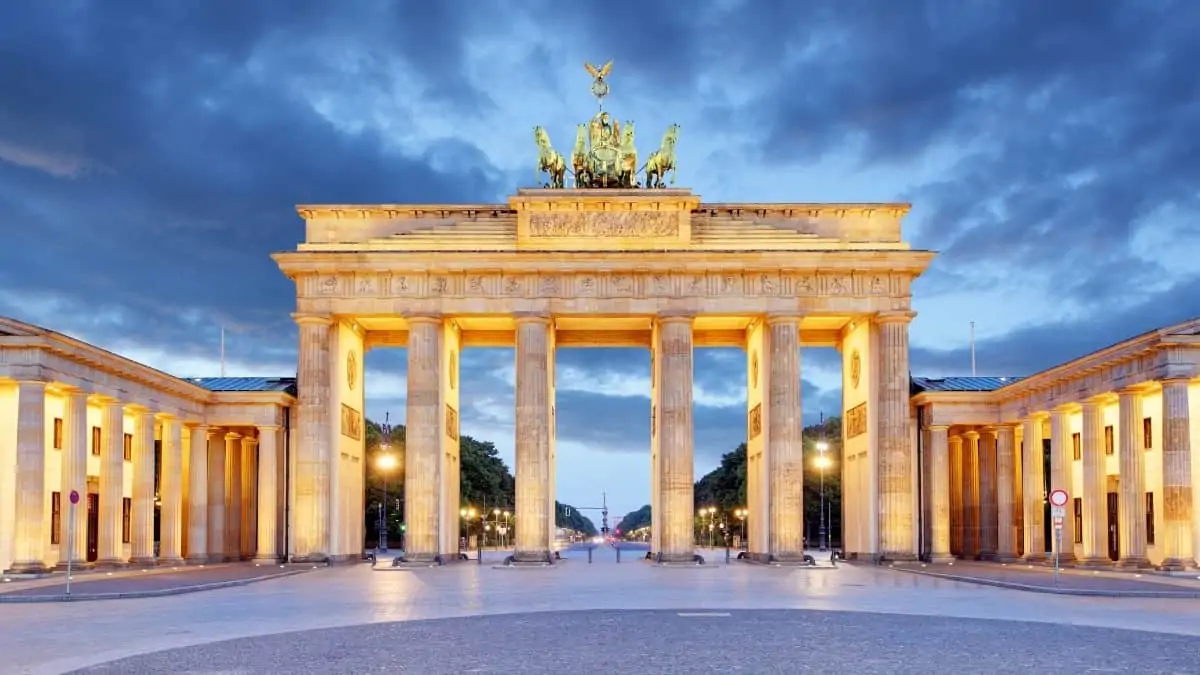
The Brandenburg Gate (Brandenburger Tor) is Berlin’s most famous landmark and a national symbol of Germany. Once a symbol of division during the Cold War, standing in the desolate “death strip” behind the Berlin Wall, it is now the ultimate symbol of unity and peace. Built in the late 18th century as a neoclassical triumphal arch, it dominates the Pariser Platz at the end of the Unter den Linden boulevard.
What to expect at Brandenburg Gate
The gate is an open-air monument, not a museum you enter, but the experience is powerful.
- The Architecture: You can walk through the five passageways between the massive Doric columns. The central passage was originally reserved for the royal family, while ordinary citizens had to use the outer ones.
- The Quadriga: Look up to the top of the gate to see the famous copper sculpture of the Goddess of Victory driving a chariot drawn by four horses. This statue was once stolen by Napoleon and taken to Paris, before being returned to Berlin.
- Room of Silence: Located in the northern wing of the gate, this is a small, non-denominational room where visitors can sit in silence to reflect on history and peace, away from the noise of the city.
- Pariser Platz: The square in front of the gate is bustling with activity. It is flanked by the French and American Embassies and the luxurious Hotel Adlon. You will often see street performers, tourists, and sometimes political demonstrations here.
- The Berlin Wall Path: A row of cobblestones runs across the ground near the gate, marking exactly where the Berlin Wall once stood, blocking access to the arch for nearly 30 years.
Brandenburg Gate tickets
- Free Admission: There is no entrance fee to visit the Brandenburg Gate. It is a public monument standing in an open square.
- No Tickets Required: You do not need to book tickets, reserve a time slot, or wait in line to walk through the gate. It is accessible to everyone, 24/7.
- Tours: While the gate itself is free, many paid walking tours of Berlin start or end here. If you want a historical explanation, you can book a “Third Reich” or “Cold War” walking tour from providers like Insider Tour or Sandemans.
How to reach Brandenburg Gate
The monument is located at Pariser Platz, 10117 Berlin, marking the border between the districts of Mitte and Tiergarten.
- By S-Bahn (Train): Take lines S1, S2, S25, or S26 to the station Brandenburger Tor. The station is located directly beneath the gate.
- By U-Bahn (Subway): Take the U5 line (the “Chancellor’s Line”) to Brandenburger Tor. This line connects directly to the Central Station (Hauptbahnhof) and Alexanderplatz.
- By Bus: The famous sightseeing bus 100 stops at Reichstag/Bundestag, a 3-minute walk away. The bus 300 stops at Behrenstraße/Wilhelmstraße, also a short walk away.
- From Reichstag: It is a short 5-minute walk from the Reichstag building to the Gate.
Brandenburg Gate’s timings
- Open 24 Hours: The Brandenburg Gate is accessible 24 hours a day, 365 days a year.
- Room of Silence: The “Raum der Stille” inside the gate has specific hours, usually daily from 11:00 AM to 5:00 PM (Winter) or 6:00 PM (Summer).
How long does a visit take?
- Photo Op: If you just want to take photos and walk through the arches, you only need about 15 to 20 minutes.
- Detailed Visit: If you visit the Room of Silence, read the information boards on Pariser Platz, and walk around to the Tiergarten side to see the Reichstag nearby, plan for 45 minutes.
Best time to visit Brandenburg Gate
- Sunrise: This is the absolute best time for photographers. The square is empty, and the sun rises behind the gate (from the Unter den Linden side), creating a stunning silhouette or golden glow.
- Night: The gate is beautifully illuminated at night. Visiting after 9:00 PM offers a dramatic atmosphere and fewer crowds than during the day.
- New Year’s Eve: If you like massive crowds, the gate hosts one of Europe’s largest NYE street parties. If you dislike crowds, avoid this area entirely on December 31st.
FAQs about Brandenburg Gate
1. Is the gate wheelchair accessible?
Yes, the area around the gate is flat and paved (though some cobblestones can be bumpy). You can easily move through the arches in a wheelchair. The S-Bahn and U-Bahn station “Brandenburger Tor” has elevators.
2. Can I climb to the top?
No, visitors cannot climb to the top of the Brandenburg Gate or stand next to the Quadriga. Access to the roof is restricted to maintenance crews and special state guests.
3. Are there toilets nearby?
Yes, there are public restrooms in the Brandenburger Tor S-Bahn/U-Bahn station below ground. There is a small fee (usually €0.50 or €1.00) to use them.
4. Is it safe at night?
Yes, the area is very safe and well-lit. It is a major tourist hub and is patrolled by police (especially given the nearby US and French embassies).
5. What is the best photo spot?
For the classic shot, stand on the Pariser Platz side (East side). If you want a photo with trees in the background, go through the gate to the Tiergarten side (West side).
