
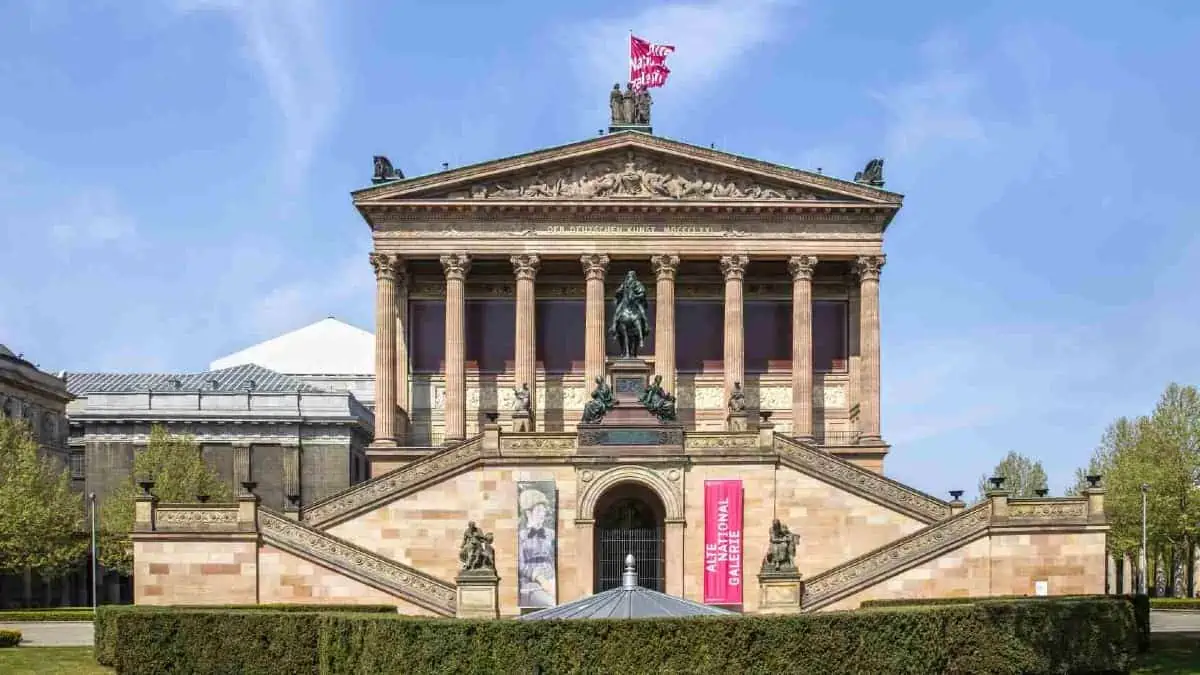
The Alte Nationalgalerie (Old National Gallery) is one of the five museums on Berlin’s UNESCO World Heritage Museum Island. Resembling a Greco-Roman temple raised on a plinth, it was built to house the comprehensive art collection of 19th-century Prussia. It is the premier destination in Berlin for Romanticism, Impressionism, and early Modernist art.
What to expect at Alte Nationalgalerie
The museum is laid out logically by floor, with each level dedicated to specific art movements. You typically start at the top and work your way down.
- 3rd Floor: Romanticism & The Age of Goethe:
This floor is the highlight for many. It houses the world-famous works of Caspar David Friedrich, the icon of German Romanticism.
Must-See: “The Monk by the Sea” and “The Abbey in the Oakwood”—two haunting landscapes that revolutionized how nature was depicted in art. - 2nd Floor: Impressionism & Realism:
The Nationalgalerie was one of the first museums in the world to buy Impressionist art. This floor features vibrant works by Monet, Renoir, and Manet.
Must-See: “In the Conservatory” by Édouard Manet—a controversial masterpiece of detachment and gaze.
Must-See: “The Iron Rolling Mill” by Adolph Menzel. This is a gritty, realistic depiction of industrial labor, contrasting sharply with the romantic landscapes upstairs.
Works by Max Liebermann and Lovis Corinth show the transition into German Modernism. - 1st Floor: Sculpture & Classical Antiquity:
The entrance hall and first floor are dedicated to classicist sculpture.
Must-See: The Princess Group (Prinzessinnengruppe) by Johann Gottfried Schadow. This double statue of Princesses Luise and Friederike is a masterwork of grace and intimacy. - Special Exhibitions (Late 2025 Note):
From October 2025 to February 2026, the museum hosts “The Scharf Collection”, featuring rare works by Goya, Monet, and Cézanne. Expect some galleries to be rearranged to accommodate this major show.
Alte Nationalgalerie’s tickets
Ticket prices can vary depending on whether a major special exhibition is running.
- Regular Admission: Approximately €14.00.
- Special Exhibition Price (Late 2025): During “The Scharf Collection” (Oct 2025 – Feb 2026), the price increases to €16.00.
- Reduced: Approximately €7.00 – €8.00 (Students, disabled persons, unemployed).
- Children (Under 18): Free, but you must book a “0 EUR” ticket for them.
- Museum Island Day Ticket: €24.00. This allows access to all open museums on the island (Altes, Neues, Bode, etc.) for one day.
- Museum Pass Berlin: Holders of the 3-day pass get free entry (included).
- Booking: It is highly recommended to book a time-slot ticket online via the official SMB website, especially for weekends.
How to reach
The museum is located at Bodestraße 1-3, 10178 Berlin, in the center of Museum Island.
- By U-Bahn (Subway): Take the U5 line to Museumsinsel. The station exits directly onto the island; the gallery is a 2-minute walk.
- By S-Bahn (Train): Take lines S3, S5, S7, or S9 to Hackescher Markt. From there, walk across the Monbijou Bridge (approx. 5-8 minutes).
- By Bus: Lines 100, 300, or N5 stop at Lustgarten or Museumsinsel.
- By Tram: Lines M1 or 12 stop at Am Kupfergraben.
Alte Nationalgalerie’s timings
- Monday: Closed
- Tuesday – Sunday: 10:00 AM – 6:00 PM
- Holidays: Generally open on public holidays (even if they fall on a Monday), but always check for Dec 24th and 31st closures.
How long does Alte Nationalgalerie take?
- Average Visit: 1.5 to 2 hours. This gives you enough time to see the Caspar David Friedrich room (3rd floor), the Impressionists (2nd floor), and the sculpture hall (1st floor).
- Art Lovers: If you are using the audio guide for detailed commentary on specific paintings, plan for 2.5 hours.
- Express Tour: You can walk through and see the top 5 highlights (Monk by the Sea, Princess Group, In the Conservatory) in about 60 minutes.
Best time to visit Alte Nationalgalerie Berlin
- Weekday Mornings: Tuesday or Wednesday at 10:00 AM is the best time to avoid crowds. You can enjoy the romantic landscapes in silence.
- Late Afternoons: Visiting after 4:00 PM is often quieter as the large tour groups have left.
- Avoid: Weekends (especially Saturday midday) are the busiest.
- Seasonal Note: In summer, the museum can get warm as it is a historic building with limited air conditioning in some older wings (though climate control protects the art).
FAQs about Altes Nationalgalerie Berlin
1. Is the audio guide included?
Yes, the audio guide is typically included in the ticket price. It is increasingly offered as a web app (Bring Your Own Device) or downloadable app, though physical devices are often available at the counter. It is wise to bring your own headphones/earbuds just in case.
2. Is the museum wheelchair accessible?
Yes. There is a lift that provides access to all exhibition floors. The accessible entrance is usually on the side of the building (follow the signs or ask staff at the main stair).
3. Can I take photos?
Photography is permitted for private, non-commercial use. However, flash, tripods, and selfie sticks are strictly prohibited.
4. Is there a cloakroom?
Yes. For security reasons (especially during the “Scharf Collection”), bags larger than DIN A4 size (approx. 20x30cm) must be checked in the cloakroom or lockers. You will need a €1 or €2 coin as a deposit for the lockers.
5. Is there a café inside?
No, there is no café directly inside the Alte Nationalgalerie. However, there are cafés in the nearby Altes Museum or the Kolonnadenhof (Colonnade Courtyard) right outside during warmer months.
